

During the Era of the Revival of the New Epoch of the Powerful State, special attention is being paid to comprehensive development in all sectors of the country, including scientific research.
The Program “Reducing Seismic Risk in Seismically Hazardous Zones of Turkmenistan” (2019–2030), approved by the Decree No. 1061 of the President of Turkmenistan dated January 23, 2019, as well as the “State Program for the Comprehensive Development of Seismology Science in Turkmenistan for 2022–2028”, approved by Decree No. 245 adopted on September 9, 2022, are aimed at ensuring the seismic safety of our country, expanding the scope of seismic surveys, and improving national expertise in this field.
The implementation of the tasks set out in these programs indicates that the deep scientific analysis of the nature of earthquakes, their magnitude, intensity, and the impact they have on people, buildings, and infrastructure facilities is one of the important directions of the current era.
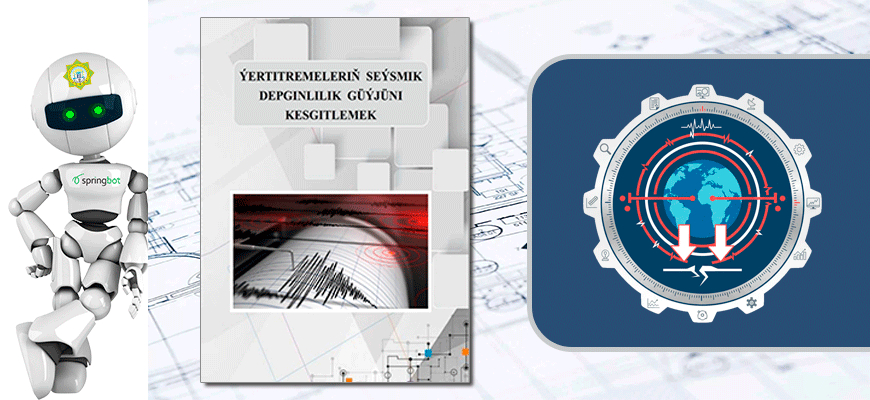
In this context, the training manual entitled “Determining the Intensity of Seismic Activity of Earthquakes” by S. Izyumov, G. Begenjov, and Y. Myradov, prepared jointly by the Turkmen State Architecture and Construction Institute and the Institute of Physics of the Atmosphere of the Academy of Sciences of Turkmenistan, comprehensively covers the fundamentals of seismology, the physical nature of earthquakes, the characteristics of seismic waves, seismic zonation, and various methods for assessing intensity.
The main goal of the training manual is to explain the theoretical and practical basis for determining the intensity level of seismic events, as well as to show the analysis of the regional macroseismic scale used in Turkmenistan through comparison with international seismic scales (MSK-64, EMS-98, MMI, and others).
The training manual describes the methodologies for conducting macroseismic surveys, organizing questionnaires among the population, assessing damage to buildings and structures, and studying the psychological and physiological effects of earthquakes on people. Furthermore, practical guidelines are provided for collecting relevant data, compiling seismic maps, and analyzing seismic hazard.
This training manual is intended for seismologists, geophysicists, civil engineers, urban planning specialists, as well as students studying in relevant fields at institutions of higher education.
It can be used as an important guide in determining the intensity of seismic activity, assessing seismic hazards, and planning earthquake-resistant construction.
Prepared by: Amanmyrat ARAZOW,
Head of the Science Department
at the Turkmen State Architecture and Construction Institute
