

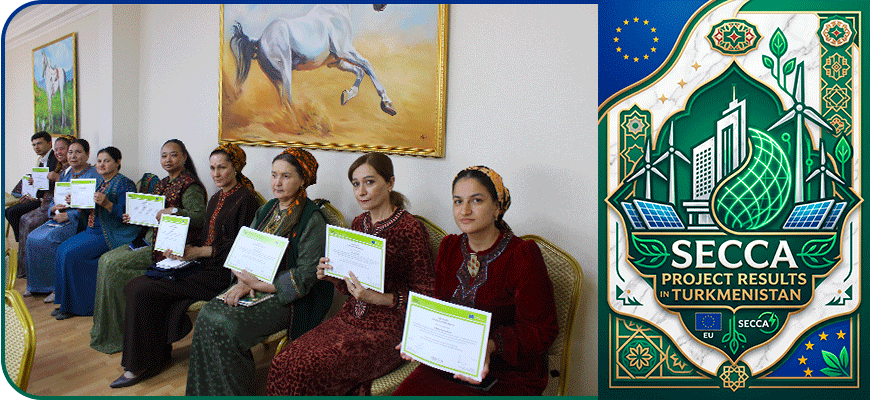
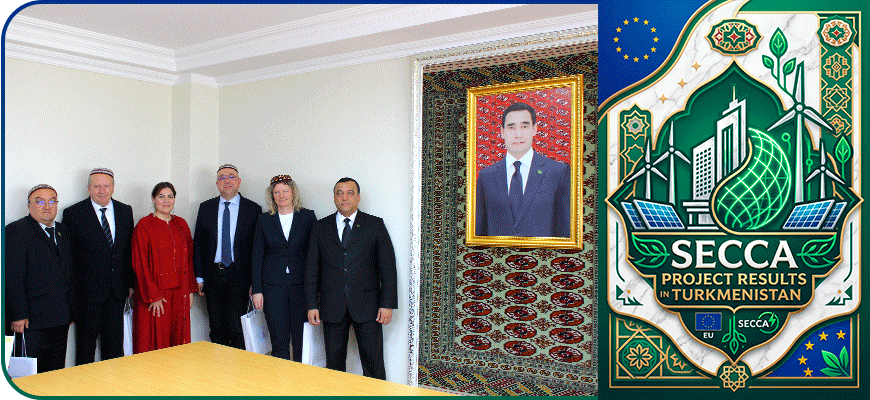
On April 29, 2026, a concluding round table titled "Results of SECCA Project Activities in Turkmenistan" was held at the Turkmen State Architecture and Construction Institute, marking the culmination of years of international cooperation. This event served as a vital platform for reporting on the fundamental transformations achieved in the fields of energy efficiency and renewable energy sources in our country and for defining directions for future partnership.
The round table was jointly organized by the Turkmen State Architecture and Construction Institute and two major international projects: the United Nations Development Programme and Global Environment Facility (UNDP/GEF) project "Enhancing National Capacities of Turkmenistan through the Improvement of the Regulatory and Legal Framework for the Energy-Efficient and Sustainable Construction Sector" and the European Union project "Sustainable Energy Connectivity in Central Asia" (SECCA). The event brought together representatives from government agencies, international organizations, and the scientific community to analyze the national-level results of the regional energy strategy.
During the round table, particular attention was paid to the milestones achieved by the SECCA project in Turkmenistan. A significant contribution to the modernization of the regulatory and legal framework in the construction and energy sectors was highlighted as one of the project's greatest successes. Specifically, the conduct of energy audits, the development of new standards for building energy efficiency, and the integration of international "green" norms into national legislation were presented as concrete project outcomes. These efforts have established a solid foundation for Turkmenistan’s transition toward low-carbon development and the fulfillment of international climate commitments.
However, the meeting addressed not only successes but also "problematic issues" and challenges. Experts drew attention to technical obstacles encountered in the large-scale implementation of new technologies, the necessity of further enhancing the professional qualifications of specialists, and the improvement of financing mechanisms for innovative projects. The analysis of these problematic issues allowed for the creation of a "roadmap" for future projects and the extraction of lessons from the experience gained.
Under the leadership of the Honorable President Serdar Berdimuhamedov, Turkmenistan demonstrates its commitment to international environmental initiatives and sustainable energy policies. Projects like SECCA, while ensuring the country's energy security, also enhance its international competitiveness. By improving the energy efficiency of buildings and utilizing renewable energy sources, a culture of rational natural resource management is being established.
The concluding meeting saw active participation not only from project organizers but also from leading representatives of the nation’s energy and education systems. Experts from the Delegation of the European Union to Turkmenistan, the UNDP construction sector project, and major international projects such as "SECCA" and "EURECA" participated and shared their expertise. The involvement of specialists from the Ministry of Energy of Turkmenistan, the "Turkmenenergo" State Electric Power Corporation, and the "Turkmenenergoproekt" Design Institute further increased the practical significance of the decisions adopted at the meeting.
Furthermore, to showcase the country's scientific and educational potential, several higher education institutions participated representing the Ministry of Education of Turkmenistan. Specifically, professors, teachers, and students from the Yagshygeldi Kakaýew International University of Oil and Gas, the Turkmen State Architecture and Construction Institute, the International University for the Humanities and Development, and the Magtymguly Turkmen State University delivered presentations. The participation of representatives from the Ashgabat Energy Secondary Vocational School and the State Energy Institute of Turkmenistan (via digital system) served as evidence that knowledge of "green" energy is being integrated across all levels of education.
At the conclusion of the round table, participants confirmed the effectiveness of the SECCA project's activities in Turkmenistan and its significant contribution to the country’s sustainable development. Speakers emphasized that the work carried out is a crucial step toward building an ecologically sustainable and economically powerful state for future generations. The meeting concluded its work with the adoption of a final document outlining new directions for future cooperation.
Science Department
of the Turkmen State Architecture and Construction Institute
